
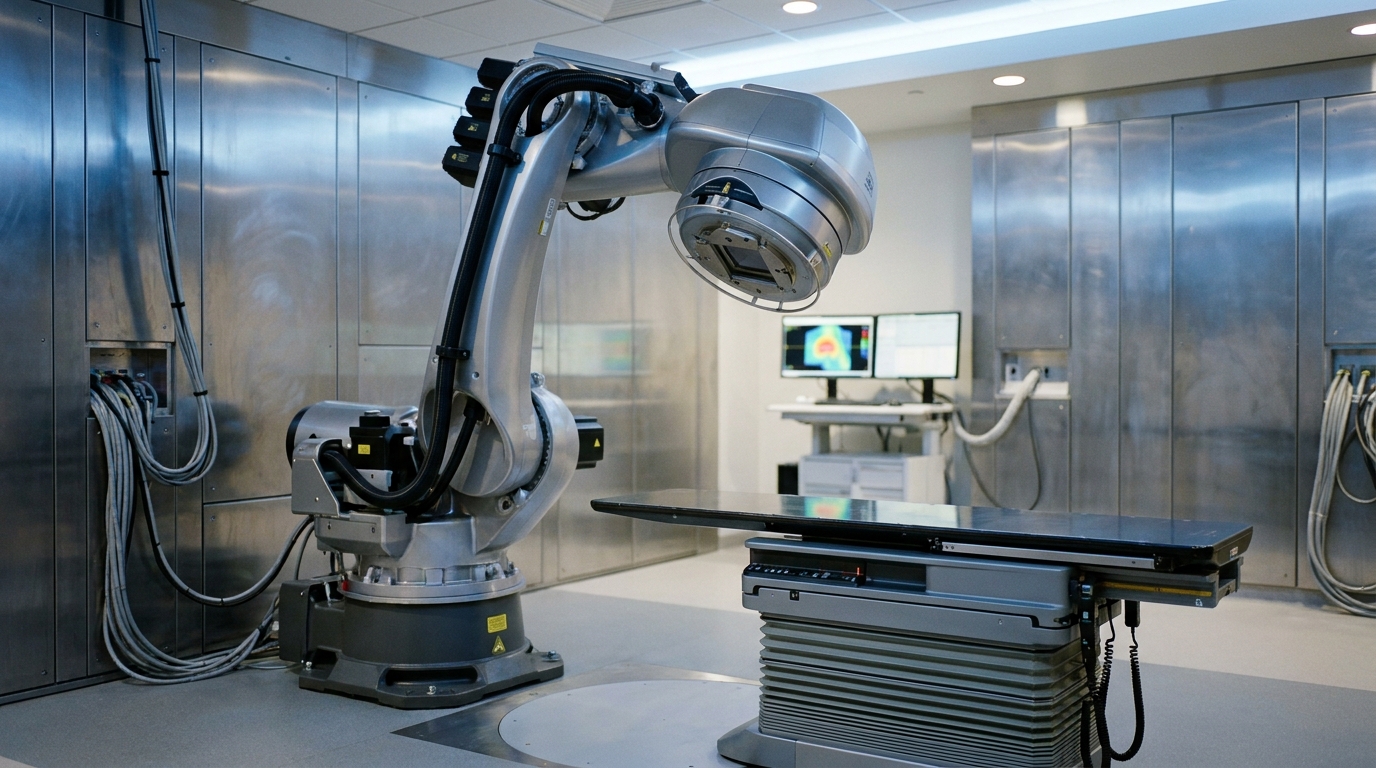
- Researchers investigated the long term durability and safety of stereotactic body radiotherapy for organ confined prostate cancer beyond five years.
- This multi center trial followed 310 patients with low or intermediate risk disease receiving 40 Gy in five fractions.
- At ten years, the relapse free survival reached 90 percent while late grade 3 or higher toxicity remained below 2 percent.
- The authors concluded that this radiotherapy method provides durable cancer control and minimal late complications over a ten year period.
- These findings support using stereotactic body radiotherapy as a safe standard treatment for patients with localized, low risk prostate cancer.
Long-term Durability of Ultra-hypofractionated Prostate Radiotherapy
Management of localized prostate cancer has increasingly shifted toward ultra-hypofractionated regimens such as stereotactic body radiotherapy (SBRT), a technique that delivers highly conformal, high-dose radiation in five or fewer fractions. Short-term data from the phase 3 PACE-B trial demonstrated that SBRT does not increase acute or two-year gastrointestinal and genitourinary toxicity compared to moderately hypofractionated schedules [1, 2]. Furthermore, five-year prospective data suggest that these condensed treatments maintain quality of life and provide high rates of biochemical control [3]. However, the unique prostate-specific antigen (PSA) kinetics following SBRT, including a high frequency of benign PSA bounces (transient elevations in PSA that do not indicate cancer recurrence), can complicate long-term monitoring and patient counseling [4]. Despite the widespread adoption of these techniques, clinicians have lacked robust data regarding the long-term durability of cancer control and the risk of very late-onset adverse events. A new multi-center study now offers decade-long outcomes, confirming that SBRT remains a safe and effective standard treatment for low-risk and intermediate-risk prostate cancer.
Trial Design and Precision Delivery Parameters
This multi-center, nonrandomized clinical trial was conducted across 21 centers to evaluate the long-term efficacy of ultra-hypofractionated radiotherapy. The study enrolled 310 evaluable patients with a median age of 68 years, all treated between January 2008 and April 2010. To establish a definitive benchmark for disease control and late-term toxicity, the cohort was stratified by disease severity into 172 low-risk patients and 138 intermediate-risk patients. Treatment was delivered using a noncoplanar robotic platform, a system that directs radiation beams from hundreds of different angles around the patient rather than restricting them to a single plane. Because the prostate frequently shifts during treatment due to bowel or bladder filling, the platform employed real-time motion management, a continuous tracking system that adjusts the radiation beam in response to internal organ movement. This precision allowed clinicians to safely deliver a total radiation dose of 40 Gy administered in five fractions of 8 Gy each. To isolate the specific therapeutic effect of the radiotherapy and avoid confounding variables in the survival data, the study protocol strictly prohibited the use of adjuvant hormone therapy (androgen deprivation therapy). For practicing oncologists, this strict monotherapy design provides a clear picture of what SBRT can achieve on its own.
Decade-Long Oncological Control and Survival
The researchers established a median follow-up duration of 9 years to assess the long-term efficacy of the SBRT protocol. Over this period, the 10-year overall survival rate for the entire study population reached 84%. To ensure clinical consistency, the study utilized the standard Phoenix criteria to define biochemical failure, characterized by a rise in prostate-specific antigen levels of 2 ng/mL or more above the post-treatment nadir (the lowest level a patient's PSA reaches after radiation). Relapses were defined comprehensively as the occurrence of biochemical failure, clinical failure, or the initiation of any salvage or systemic prostate cancer therapy. Under these rigorous definitions, the 10-year overall relapse-free survival was 90%, demonstrating that the therapeutic effect of the five-fraction regimen remains highly stable well into the second decade post-treatment. Stratification by baseline risk categories provided more granular insights into the durability of oncological control. In the low-risk cohort, the 10-year relapse-free survival was 94%, while the intermediate-risk cohort demonstrated a 10-year relapse-free survival of 86%. When the intermediate-risk group was further divided into prognostic subgroups, the data revealed a significant divergence in outcomes. Patients in the favorable intermediate-risk subgroup maintained a 10-year relapse-free survival of 92%, a figure nearly comparable to the low-risk group. Conversely, the unfavorable intermediate-risk subgroup showed a 10-year relapse-free survival of 77%. These findings provide clinicians with specific benchmarks for counseling patients on long-term expectations, highlighting the need for closer surveillance in patients with unfavorable intermediate-risk disease.
Late-Onset Toxicity and Safety Profile
The researchers evaluated the long-term safety of the 40 Gy regimen by monitoring late toxicities, defined as adverse events occurring more than 90 days after the completion of treatment. Complications were assessed using the Common Terminology Criteria for Adverse Events version 3 (CTCAE v3), a standardized grading system where higher scores indicate increasing severity of side effects. Over the decade of observation, the incidence of severe complications remained exceptionally low across both risk groups. Specifically, the 10-year cumulative grade 3 gastrointestinal or genitourinary toxicity was 1.4% in the low-risk cohort and 1.5% in the intermediate-risk cohort. These grade 3 events represent severe or medically significant complications that require intervention but do not pose an immediate threat to life, suggesting that the high-dose delivery does not result in a high burden of major late-term organ damage. When examining moderate side effects, the study found a divergence between bowel and bladder outcomes. The 10-year grade 2 or higher gastrointestinal toxicity rate was 2.1%, whereas the 10-year grade 2 or higher genitourinary toxicity rate was 14%. Grade 2 toxicities are symptomatic conditions requiring local or noninvasive intervention, such as medication for urinary frequency or minor bowel changes. Most importantly for clinical safety counseling, the researchers reported that no grade 4 or grade 5 adverse events were observed during the follow-up period, meaning there were no life-threatening complications or treatment-related deaths. For the practicing urologist or radiation oncologist, these data provide a robust safety benchmark, demonstrating that robotic SBRT maintains a high degree of tissue preservation over 10 years with a negligible risk of catastrophic late-onset toxicity.
References
1. Tree A, Ostler P, Voet HVD, et al. Intensity-modulated radiotherapy versus stereotactic body radiotherapy for prostate cancer (PACE-B): 2-year toxicity results from an open-label, randomised, phase 3, non-inferiority trial. The Lancet Oncology. 2022. doi:10.1016/s1470-2045(22)00517-4
2. Brand D, Tree A, Ostler P, et al. Intensity-modulated fractionated radiotherapy versus stereotactic body radiotherapy for prostate cancer (PACE-B): acute toxicity findings from an international, randomised, open-label, phase 3, non-inferiority trial. The Lancet Oncology. 2019. doi:10.1016/s1470-2045(19)30569-8
3. Zilli T, Jorcano S, Bral S, et al. Every-other-day vs once-a-week urethra-sparing prostate SBRT: 5-year results of a randomized phase II trial.. International Journal of Radiation Oncology, Biology, Physics. 2023. doi:10.1016/j.ijrobp.2023.03.057
4. Dejonckheere CS, Caglayan L, Glasmacher AR, et al. Prostate-specific antigen kinetics after stereotactic body radiotherapy for localized prostate cancer: A scoping review and meta-analysis.. Radiotherapy and oncology : journal of the European Society for Therapeutic Radiology and Oncology. 2025. doi:10.1016/j.radonc.2024.110642