For Doctors in a Hurry
- Elevated plasminogen activator inhibitor 1 levels increase thrombotic risk and age-related morbidity, yet effective long-term suppression strategies remain clinically limited.
- Researchers evaluated a small interfering RNA lipid nanoparticle delivery system across young, aged, and diet-induced obese mouse models.
- A single dose achieved 90 percent plasma knockdown for ten days and significantly reduced thrombus weight in aged mice.
- The study concludes that targeted gene therapy effectively normalizes supraphysiologic protein concentrations and extends lifespan in accelerated aging models.
- This approach offers a potential long-term anti-thrombotic strategy to mitigate the pathologic impact of aging and obesity-related vascular complications.
Systemic chronic inflammation serves as a primary driver for cellular senescence and the progression of age-related metabolic and cardiovascular disorders [1]. Within this inflammatory milieu, the dysregulation of fibrinolysis, the physiological process responsible for degrading blood clots, significantly increases the risk of life-threatening thrombotic events [2]. While traditional management focuses on lipid modification and standard anticoagulation, these approaches often fail to address the underlying molecular shifts that occur as patients age [3, 4]. Emerging evidence suggests that specific proteins within the coagulation cascade may be amenable to highly targeted genetic modulation using small interfering RNA delivered via lipid nanoparticles [5]. A recent study evaluates whether silencing a key inhibitor of fibrinolysis can safely mitigate thrombotic risk and influence the broader trajectory of aging, offering a potential new pathway for managing chronic cardiovascular risk.
The Pathological Role of PAI-1 in Aging and Obesity
Plasminogen activator inhibitor 1 (PAI-1) serves as a primary inhibitor of fibrinolysis, the physiological process responsible for the enzymatic breakdown of blood clots. By neutralizing the activity of tissue-type and urokinase-type plasminogen activators, PAI-1 promotes blood clot stabilization, a mechanism that becomes increasingly maladaptive in the context of chronic disease. Beyond its role in the coagulation cascade, the researchers note that PAI-1 contributes to the pathogenesis of diet-induced obesity and a broad spectrum of age-associated conditions, including diabetes, cancer, and Alzheimer's disease. These associations suggest that PAI-1 acts as a pleiotropic mediator of systemic decline, influencing multiple distinct disease pathways rather than simply regulating hemostasis. Clinical data indicate that circulating levels of PAI-1 increase as a function of chronological age. This age-dependent elevation contributes to the heightened thrombotic risk frequently observed in geriatric patients and those with age-related comorbidities. Conversely, the study highlights that partial PAI-1 deficiency protects patients from cardiovascular morbidity and extends lifespan, suggesting that the protein is a viable target for therapeutic down-regulation. Because decreasing circulating PAI-1 levels has demonstrated both experimental and therapeutic value, the researchers sought to determine if suppressing this fibrinolytic brake could mitigate the pathological impacts of aging and metabolic dysfunction. For practicing physicians, targeting PAI-1 could eventually translate into therapies that simultaneously reduce deep vein thrombosis risk and address underlying metabolic decline.
Sustained Protein Silencing via Lipid Nanoparticle Delivery
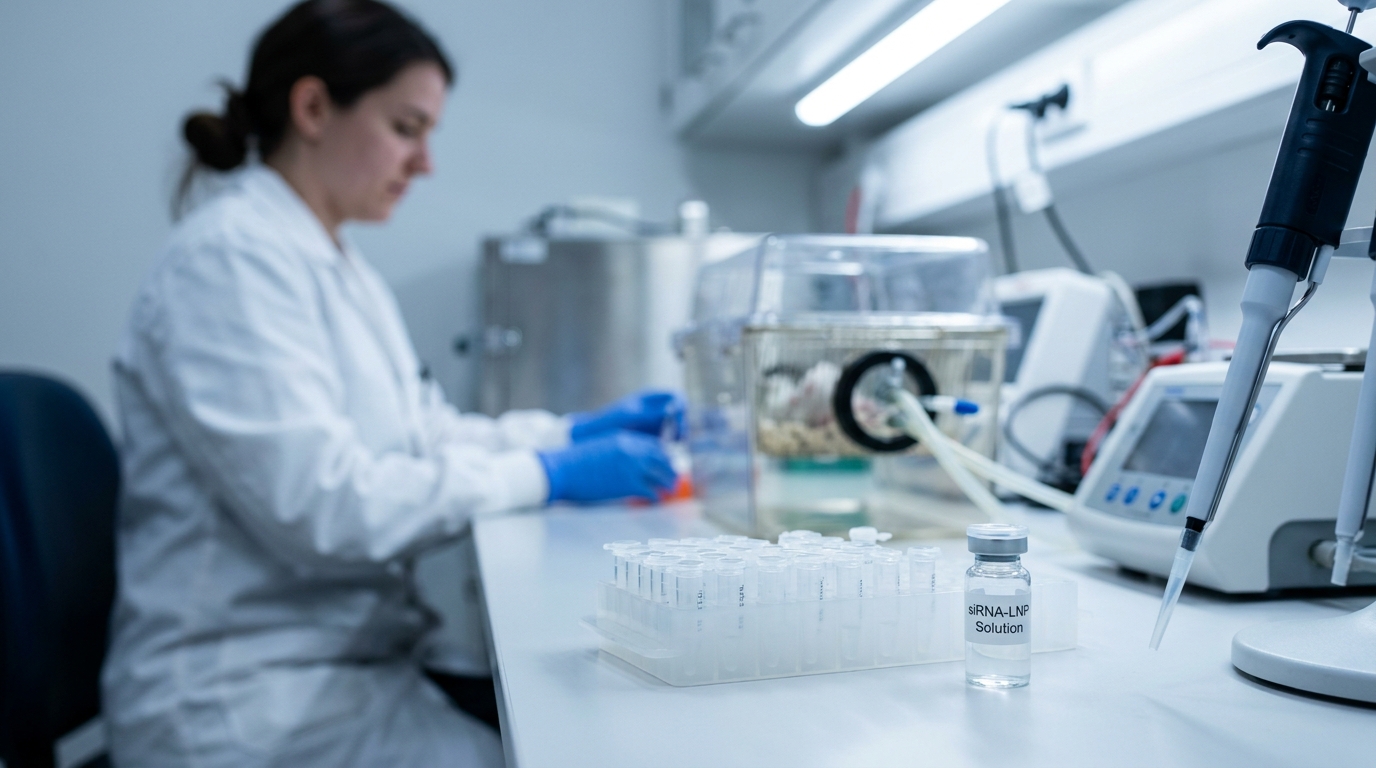
Traditional pharmacological interventions often struggle to modulate proteins that lack accessible binding pockets for small molecules or those that are not easily targeted by monoclonal antibodies. To address these limitations, the researchers utilized RNA gene therapy, a method that regulates target protein levels by interfering with the translation process. Specifically, the team developed a delivery system using small interfering RNA (siRNA), which are short sequences of double-stranded RNA that silence specific gene expression, encapsulated within lipid nanoparticles. This formulation, designated as siPAI-1, was designed to induce long-lasting PAI-1 knockdown in vivo. The efficacy of this delivery platform was demonstrated through a single-dose administration in murine models. The researchers found that one dose of siPAI-1 resulted in 90% knockdown of plasma PAI-1, effectively suppressing the circulating levels of this fibrinolytic inhibitor. This 90% knockdown of plasma PAI-1 lasted 10 days post-administration, suggesting a durable therapeutic window from a single intervention. Furthermore, the safety profile of the lipid nanoparticle delivery system was favorable, as no overt toxicity was observed following the administration of siPAI-1. These findings indicate that siRNA-mediated silencing can provide sustained protein modulation without the acute adverse effects often associated with systemic gene-silencing therapies, raising the possibility of infrequent dosing regimens for chronic cardiovascular management.
Mitigating Thrombotic Risk in Obese and Aged Populations
The researchers investigated the metabolic drivers of PAI-1 elevation, focusing on the liver as a primary source of circulating protein. In murine models of diet-induced obesity, hepatic PAI-1 mRNA expression was more than 10 times higher than in healthy mice, highlighting the significant impact of metabolic dysfunction on fibrinolytic inhibition. This increase in gene expression was not uniform across the cohort; rather, hepatic PAI-1 mRNA expression was exponentially correlated with body weight in obese mice, suggesting that advancing obesity disproportionately accelerates the pro-thrombotic state. To test the therapeutic potential of gene silencing in this high-risk metabolic context, the authors administered a single dose of siPAI-1 to the obese models. This intervention achieved a 70% knockdown of circulating PAI-1 in obese mice, demonstrating that RNA interference can effectively lower supraphysiologic protein levels even in the presence of severe metabolic stress. To evaluate the clinical implications of these findings for acute vascular events, the study utilized a model of complete ligation of the inferior vena cava (IVC), a surgical procedure that induces a stable blood clot mimicking human deep vein thrombosis. The administration of siPAI-1 significantly altered the thrombotic response across different age groups. Specifically, siPAI-1 decreased thrombus weight following complete ligation of the IVC in young mice, and this effect was mirrored in older cohorts where siPAI-1 decreased thrombus weight following complete ligation of the IVC in aged mice. Beyond reducing the physical size of the clot, the therapy provided a clear mortality benefit in the most vulnerable subjects. The researchers found that siPAI-1 increased survival in aged mice four days post-IVC ligation, suggesting that normalizing PAI-1 levels may eventually help mitigate the lethal complications of acute venous thromboembolism in elderly patients.
Normalization of Fibrinolysis and Impact on Longevity
The transition from acute thrombotic protection to chronic disease management depends on the ability to maintain physiological protein levels over time. In this study, the researchers demonstrated that siPAI-1 normalized the supraphysiologic concentration of PAI-1 in aged mice, effectively resetting the fibrinolytic balance to a state more characteristic of younger animals. This normalization is clinically significant because PAI-1 levels typically rise with age, creating a pro-thrombotic environment that resists natural clot dissolution. By using siRNA delivered via lipid nanoparticles, the authors were able to suppress these elevated concentrations (levels far exceeding the normal physiological baseline) without inducing complete protein depletion, which could otherwise trigger bleeding complications. Beyond the immediate reduction in vascular risk, the study explored the systemic effects of sustained fibrinolytic regulation on the aging process itself. The researchers found that siPAI-1 prolonged lifespan in a fast-aging mouse model, a finding that suggests PAI-1 inhibition may influence the broader biological drivers of senescence. These results indicate that siRNA-mediated PAI-1 knockdown represents a long-term anti-thrombotic approach and effective strategy to limit the pathologic impact of PAI-1 in aging and age-related diseases. For clinicians, this points toward a future therapeutic pathway that could address both the acute risk of venous thromboembolism and the chronic progression of age-related vascular pathology through a single, long-acting molecular intervention.
References
1. Li X, Li C, Zhang W, Wang Y, Qian P, Huang H. Inflammation and aging: signaling pathways and intervention therapies. Signal Transduction and Targeted Therapy. 2023. doi:10.1038/s41392-023-01502-8
2. Ferraresso F, Leung J, Kastrup CJ. RNA therapeutics to control fibrinolysis: review on applications in biology and medicine.. Journal of thrombosis and haemostasis : JTH. 2024. doi:10.1016/j.jtha.2024.04.006
3. Mach F, Baigent C, Catapano AL, et al. 2019 ESC/EAS Guidelines for the management of dyslipidaemias: lipid modification to reduce cardiovascular risk. European Heart Journal. 2019. doi:10.1093/eurheartj/ehz455
4. Kong P, Cui Z, Huang X, Zhang D, Guo R, Han M. Inflammation and atherosclerosis: signaling pathways and therapeutic intervention. Signal Transduction and Targeted Therapy. 2022. doi:10.1038/s41392-022-00955-7
5. Gabrielsen A, Ueckert S, Nilsson C, et al. RNA interference therapy targeting coagulation factor XI: a first-in-human trial of RBD4059 (vortosiran).. Blood advances. 2026. doi:10.1182/bloodadvances.2025018348