
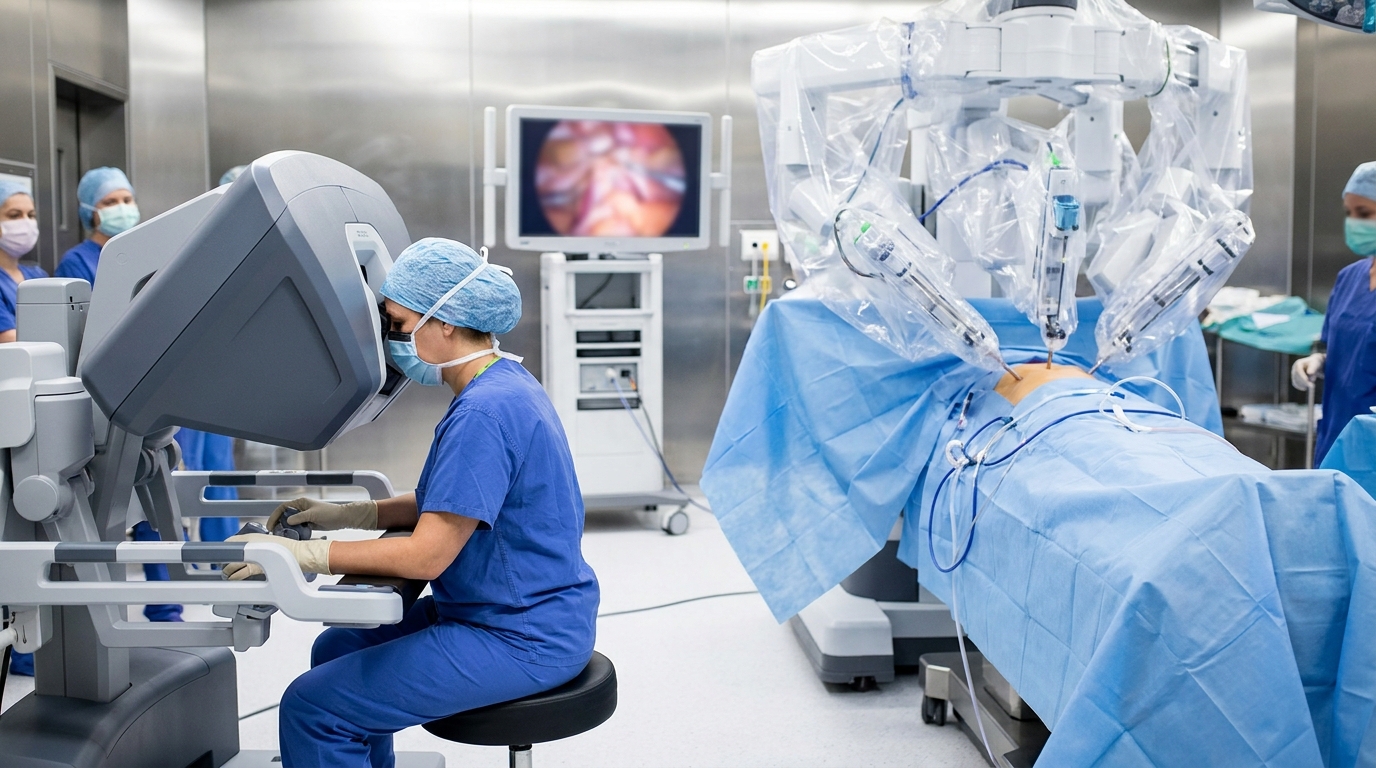
- Researchers investigated if robot-assisted kidney transplantation reduces short-term surgical complications compared to the standard open surgical technique.
- This randomized trial at a single center assigned 107 adult patients to receive either robot-assisted or open kidney transplantation.
- Major surgical complications occurred in 13 percent of robotic patients and 25 percent of open surgery patients (p=0.2).
- The study found no statistically significant superiority for the robotic approach despite a 9.4 percent reduction in vascular complications.
- These findings provide a rationale for larger multicentre trials to confirm if robotic surgery reduces postoperative morbidity.
Refining Surgical Standards in Renal Transplantation
Kidney transplantation remains the definitive treatment for end-stage kidney disease, yet graft success is heavily contingent on a complication-free surgical procedure [1]. While open kidney transplantation is the traditional standard, robot-assisted techniques have been introduced to provide a minimally invasive alternative for this medically complex patient population [2]. Meta-analyses of observational data suggest that robotic approaches may reduce surgical site infections and symptomatic lymphoceles (localized fluid collections in the retroperitoneum) without compromising graft survival [3, 4]. However, the high prevalence of obesity among recipients often complicates surgical access and increases the risk of wound dehiscence, or the separation of surgical margins [5]. Despite the growing adoption of robotic platforms, the lack of randomized evidence has historically limited the ability of clinicians to justify replacing established open techniques. A new randomized trial now provides the first direct comparison of these two surgical modalities.
Trial Design and Patient Selection
The ORAKTx trial is the first randomized, parallel, open-label study to directly compare robot-assisted kidney transplantation with the traditional open surgical approach. Conducted at Copenhagen University Hospital, Rigshospitalet, in Denmark, the trial enrolled adult patients with end-stage kidney disease who were scheduled to undergo living or deceased donor kidney transplantation and had no contraindications to robotic surgery. A total of 107 participants were initially assigned to the study arms, with 54 patients randomized to receive robot-assisted surgery and 53 patients assigned to the open surgery group. Ultimately, 53 participants in each arm underwent their respective procedures and completed the necessary follow-up. The researchers defined the primary outcomes as the 30-day post-transplant rates of vascular and major surgical complications. These endpoints were selected to capture the most critical short-term risks associated with the procedure, such as arterial thrombosis, venous issues, and significant postoperative morbidity. By focusing on these specific clinical events within the first month following transplantation, the trial aimed to determine if the robotic platform could offer a measurable reduction in surgical burden, potentially leading to faster recovery times and shorter hospital stays for a high-risk patient population.
Comparative Safety and Surgical Outcomes
Among the 106 patients who completed the full follow-up period for the primary analysis (53 participants in each arm), the robotic approach demonstrated a notable, though not statistically significant, reduction in adverse events. When evaluating the incidence of major surgical complications within 30 days, the researchers observed that 13 patients (25%) in the open transplantation arm experienced major complications compared to 7 patients (13%) in the robot-assisted transplantation arm. This yielded a risk difference of -11% (95% confidence interval [CI]: -26 to 3.4, p = 0.2). Vascular complications, which represent a critical risk to early graft survival and patient safety, followed a similar trend favoring the robotic approach. These complications occurred in 10 patients (19%) in the open transplantation arm, while only 5 patients (9.4%) in the robot-assisted transplantation arm were affected. The calculated risk difference for vascular complications was -9.4% (95% CI: -23 to 3.7, p = 0.3). Despite the observed 50% relative reduction in the rate of vascular events, the findings indicate that robot-assisted kidney transplantation was not statistically superior to open kidney transplantation for these primary endpoints. For the practicing transplant nephrologist or surgeon, however, the absolute risk reductions of 9.4% for vascular issues and 11% for major surgical complications suggest a clinically relevant decrease in postoperative morbidity that could translate to fewer return trips to the operating room and improved early graft function.
Clinical Implications and Future Directions
The ORAKTx trial provides a critical assessment of robot-assisted kidney transplantation, though the researchers noted several constraints that influence the interpretation of these results. The study was characterized by a single-center design and a lack of blinding, which are common challenges in surgical trials where the intervention is physically evident to the operating team. Furthermore, the modest sample size of 106 total patients likely limited the statistical power necessary to reach significance for the primary endpoints. Despite these limitations, the researchers observed a substantially lower absolute rate of vascular and major complications in the robotic arm, with major complications occurring in 13 patients (25%) in the open arm versus 7 patients (13%) in the robotic arm, and vascular complications occurring in 10 patients (19%) in the open arm versus 5 patients (9.4%) in the robotic arm. For the practicing transplant surgeon, these findings suggest a potentially meaningful decrease in postoperative morbidity with robot-assisted surgery despite the study not meeting its primary endpoint of statistical superiority. The reduction in vascular complications (risk difference: -9.4%, 95% CI: -23 to 3.7, p = 0.3) and major surgical complications (risk difference: -11%, 95% CI: -26 to 3.4, p = 0.2) points toward a clinical benefit that could improve early graft function and reduce the need for secondary interventions. Because the trial demonstrated a clear trend toward improved safety profiles, the authors conclude that these findings confirm a rationale for undertaking larger multicenter trials. Such expanded studies will be essential to determine if the observed absolute risk reductions of 9.4% and 11% can be replicated across diverse surgical teams and larger patient populations to establish updated surgical standards in renal transplantation.
References
1. Ortved M, Dagnæs-Hansen J, Stroomberg HV, et al. Open-label randomised clinical trial investigating whether robot-assisted kidney transplantation can reduce surgical complications compared to open kidney transplantation (ORAKTx): study protocol for a randomised clinical trial.. Trials. 2025. doi:10.1186/s13063-024-08706-5
2. Territo A, Bajeot A, Mesnard B, et al. Open versus robotic-assisted kidney transplantation: A systematic review by the European Association of Urology (EAU) - Young Academic Urologists (YAU) Kidney Transplant Working Group.. Actas Urológicas Españolas. 2023. doi:10.1016/j.acuroe.2023.03.003
3. Slagter JS, Outmani L, Tran KTC, IJzermans JN, Minnee RC. Robot-assisted kidney transplantation as a minimally invasive approach for kidney transplant recipients: A systematic review and meta-analyses. International Journal of Surgery. 2022. doi:10.1016/j.ijsu.2022.106264
4. O'Connor-Cordova M, Ortega-Macías AG, Sancen-Herrera JP, et al. Living donor robotic-assisted kidney transplant compared to traditional living donor open kidney transplant. Where do we stand now? A systematic review and meta-analysis.. Transplantation reviews. 2023. doi:10.1016/j.trre.2023.100789
5. Lafranca JA, IJermans JN, Betjes MG, Dor FJMF. Body mass index and outcome in renal transplant recipients: a systematic review and meta-analysis. BMC Medicine. 2015. doi:10.1186/s12916-015-0340-5