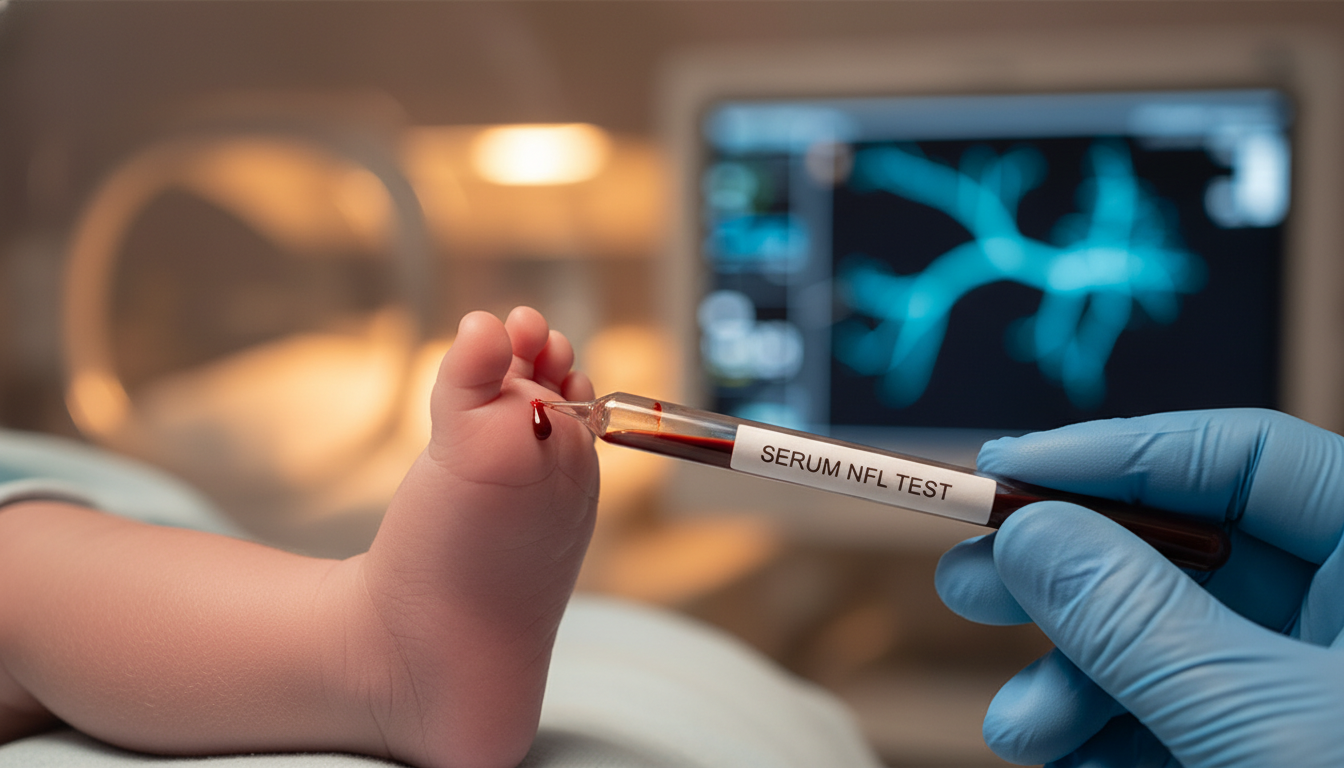
For Doctors in a Hurry
- This study addressed the lack of fluid biomarkers to predict early disease activity in newborns with spinal muscular atrophy (SMA).
- The researchers evaluated 45 individuals with SMA in a cross-sectional and longitudinal study correlating biomarkers with clinical variables.
- Pretreatment serum neurofilament light chain was significantly higher in neonates with two SMN2 copies (mean 680.9 pg/ml) versus ≥3 copies (mean 146.9 pg/ml, p=0.01).
- The authors conclude that active denervation occurs in the neonatal period for children with two SMN2 copies, preceding a clinical phenotype.
- Serum neurofilament light chain may offer early insights into pathophysiology, potentially expediting treatment initiation for newborns identified via screening.
The Evolving Landscape of SMA Management
The clinical management of spinal muscular atrophy (SMA) has transitioned toward early intervention using disease-modifying therapies such as nusinersen, onasemnogene abeparvovec, and risdiplam [1, 2, 3, 4]. Data from the phase 3 DEVOTE trial (n=75) demonstrated that high-dose nusinersen (50-mg loading dose followed by 28-mg maintenance doses) achieved a 15.1-point improvement in Children's Hospital of Philadelphia Infant Test of Neuromuscular Disorders (CHOP-INTEND) scores at day 183, whereas sham-treated controls experienced an 11.1-point decline (difference 26.19; 95% CI 20.7 to 31.74; p < 0.0001) [5]. Early treatment remains a priority, as the SPR1NT trial (n=14) reported that infants with two copies of the survival motor neuron 2 (SMN2) gene reached 100% survival without permanent ventilation at 14 months after receiving onasemnogene abeparvovec [6, 7, 8]. However, the RESPOND trial (n=37) highlighted that some infants continue to show elevated neurofilament light chain (NfL) levels, a protein marker of axonal injury, and low compound muscle action potential (CMAP) amplitudes, which measure the electrical response of motor units, even after gene transfer therapy [9, 10]. These findings suggest that subclinical neurodegeneration may persist, requiring objective biomarkers to guide therapeutic adjustments before irreversible motor neuron loss occurs [3, 4].
Quantifying Early Axonal Injury
The study investigated neurofilament light chain (NfL) levels to characterize disease activity and predict outcomes in a cohort of 45 individuals with SMA, ranging in age from 4 days to 42 years. By measuring NfL, a cytoskeletal protein released into the extracellular space during axonal disintegration, the researchers sought to identify biochemical evidence of nerve damage that might not be captured by physical examination alone. The study correlated pretreatment serum neurofilament light chain (sNfL) and cerebrospinal fluid (CSF) levels with clinical, neurophysiological, and molecular genetic variables. The analysis demonstrated that pretreatment sNfL levels in neonates with 2 SMN2 copies were significantly higher than in those with 3 or more copies (p = 0.01). Specifically, neonates with 2 copies of the survival motor neuron 2 (SMN2) gene, a genotype associated with more severe disease, showed a mean (SE) sNfL of 680.9 (163.7) pg/ml, while those with 3 or more copies had a mean (SE) sNfL of 146.9 (59.8) pg/ml. This disparity confirms that significant axonal injury occurs within the first days of life in high-risk infants, suggesting that sNfL could serve as a critical tool for identifying patients who require the most aggressive early interventions.
Predicting Long-Term Motor Function
In the highest-risk group of neonates with 2 SMN2 copies, the researchers identified a rapid escalation of axonal damage shortly after birth. Within this cohort, serum neurofilament light chain levels showed a strong positive correlation with increasing postnatal age (r = 0.75, p = 0.005), indicating that the rate of nerve fiber breakdown accelerates during the neonatal period. To improve prognostic accuracy, the researchers developed a regression model (a statistical tool used to predict an outcome based on multiple variables) that combined biochemical, electrophysiological, and clinical data. They found that integrating pretreatment sNfL levels with compound muscle action potential (CMAP) and CHOP-INTEND scores provided a stronger prediction of motor outcomes at two years (p = 0.02). CMAP is an electrophysiological measure that quantifies the total electrical response of a muscle to nerve stimulation, effectively counting the number of functional motor units. By combining this measure of current nerve function with sNfL (a measure of active damage) and CHOP-INTEND (a standardized motor scale for infants), clinicians can more accurately forecast long-term disability and tailor family counseling accordingly.
Detecting Silent Progression in Stable Patients
The researchers also performed a longitudinal assessment of sNfL levels in patients receiving nusinersen and those whose treatment was deferred due to local reimbursement criteria. In infants with three or more SMN2 copies who did not immediately start therapy, pretreatment sNfL levels increased even while motor function remained clinically stable. This observation reveals a window of silent progression where axonal injury intensifies without immediate changes in physical strength or motor milestones. The study identified a malignant disease course characterized by active denervation (the rapid loss of nerve supply to muscle fibers) in children with two SMN2 copies during the neonatal period. These findings suggest that sNfL provides essential insights into the underlying pathophysiology of SMA before the full clinical phenotype, or observable physical symptoms, becomes apparent. Consequently, the researchers suggest that the clinical application of sNfL may expedite access to the initiation of treatment by providing objective evidence of neurodegeneration. For the practicing clinician, this means that rising sNfL levels could justify earlier therapeutic intervention in infants who appear asymptomatic but are undergoing rapid, irreversible motor neuron loss.
References
1. Mehrabian A, Auguste P, Grove A, et al. Effectiveness and Safety of Nusinersen and Risdiplam in Spinal Muscular Atrophy: A Systematic Review.. Annals of clinical and translational neurology. 2026. doi:10.1002/acn3.70274
2. Baraka B, Porwal M, Kannur S, Pandey A, Khan A. Spinal Muscular Atrophy: A Systematic Review of Diagnosis, Treatment and Emerging Research. International Journal of Pharmaceutical Sciences and Drug Research. 2024. doi:10.25004/ijpsdr.2024.160519
3. Giess D, Erdos J, Wild C. An updated systematic review on spinal muscular atrophy patients treated with nusinersen, onasemnogene abeparvovec (at least 24 months), risdiplam (at least 12 months) or combination therapies.. European journal of paediatric neurology : EJPN : official journal of the European Paediatric Neurology Society. 2024. doi:10.1016/j.ejpn.2024.06.004
4. Erdös J, Wild C. Mid- and long-term (at least 12 months) follow-up of patients with spinal muscular atrophy (SMA) treated with nusinersen, onasemnogene abeparvovec, risdiplam or combination therapies: A systematic review of real-world study data. European Journal of Paediatric Neurology. 2022. doi:10.1016/j.ejpn.2022.04.006
5. Finkel RS, Crawford TO, Mercuri E, et al. High-dose nusinersen for spinal muscular atrophy: a phase 3 randomized trial. Nature Medicine. 2026. doi:10.1038/s41591-025-04193-6
6. Strauss KA, Farrar MA, Muntoni F, et al. Onasemnogene abeparvovec for presymptomatic infants with two copies of SMN2 at risk for spinal muscular atrophy type 1: the Phase III SPR1NT trial. Nature Medicine. 2022. doi:10.1038/s41591-022-01866-4
7. Aragon‐Gawinska K, Mouraux C, Dangouloff T, Servais L. Spinal Muscular Atrophy Treatment in Patients Identified by Newborn Screening—A Systematic Review. Genes. 2023. doi:10.3390/genes14071377
8. Albrechtsen SS, Born AP, Boesen MS. Nusinersen treatment of spinal muscular atrophy - a systematic review.. Danish medical journal. 2020.
9. Proud CM, Finkel RS, Parsons J, et al. Open-label phase IV trial evaluating nusinersen after onasemnogene abeparvovec in children with spinal muscular atrophy. Journal of Clinical Investigation. 2025. doi:10.1172/jci193956
10. Proud CM, Finkel RS, Parsons JA, et al. Open-label phase IV trial evaluating nusinersen after onasemnogene abeparvovec in children with spinal muscular atrophy.. The Journal of clinical investigation. 2025. doi:10.1172/JCI193956