
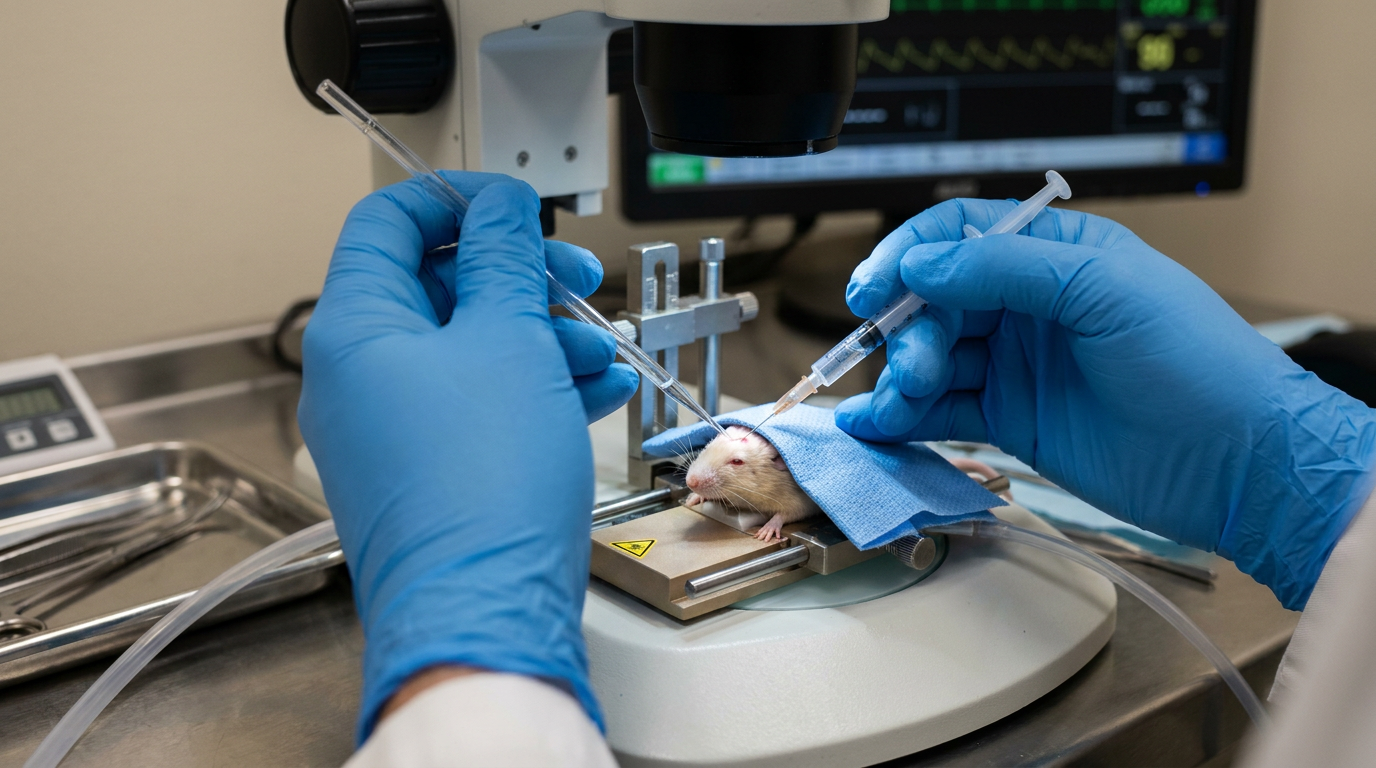
- The study investigated how mechanical forces from ciliary beating influence neural stem cell activity in fluid-filled brain cavities.
- Researchers developed a method to transiently inhibit ependymal cell cilia beating in vivo, activating neural stem cells.
- Inhibition of ependymal cell cilia beating for only a few hours triggered neural stem cell activation.
- The authors concluded that ependymal cell cilia beating regulates neural stem cell quiescence via PKD1/2 and TRPM3 calcium signaling.
- These findings suggest potential targets for modulating neural stem cell activity in neurological conditions.
Mechanical Regulation of Adult Brain Stem Cells
The adult brain's capacity for limited self-repair and plasticity hinges on quiescent neural stem cells (NSCs) housed in specialized niches, such as the ventricular-subventricular zone (V-SVZ) [1, 2]. These NSCs are typically held in a dormant state, ready for activation to generate new neurons and glia, a process essential for brain maintenance and potential repair after injury [3, 4]. The microenvironment, including the cerebrospinal fluid and adjacent ependymal cells, is known to regulate NSC behavior through a mix of chemical signals [5, 6]. However, the contribution of physical forces within this niche has been less understood. A recent study now clarifies how direct mechanical cues from the local environment are not just incidental but are in fact critical for controlling the fate of these stem cells [7, 8, 9].
Ependymal Cilia: A Mechanical Regulator of Neural Stem Cells
A new investigation reveals that the constant, rhythmic beating of cilia on ependymal cells (ECs) lining the brain's ventricles generates a mechanical force that actively maintains the quiescent state of neighboring neural stem cells (NSCs). The study demonstrates this is not a passive process but a specific signaling cascade. The mechanical stimulation is sensed by the NSCs through two specific ion channels, polycystin 1/2 (PKD1/2) and transient receptor potential melastatin 3 (TRPM3). Activation of these channels triggers brief, localized increases in intracellular calcium, known as calcium transients, which serve as the key signal to enforce dormancy. The potency of this mechanism was underscored by a key finding: inhibiting the beating of EC cilia for only a few hours was sufficient to trigger NSC activation in vivo, shifting them from a quiescent to an active state.
Investigating Cilia Function in the Forebrain Ventricle
To isolate the specific contribution of mechanical force from the complex chemical milieu of the stem cell niche, the researchers developed a targeted method to temporarily halt cilia movement. This technique was crucial for demonstrating a direct cause-and-effect relationship between the physical motion of cilia and the biological state of the NSCs. The team focused on the ependymal cells lining the forebrain ventricle, a primary site of adult neurogenesis. The method involved injecting antibodies coupled to magnetic beads, which were designed to bind specifically to the EC cilia. Following this, the application of an external magnetic field physically restrained the beads, effectively and transiently stopping the cilia from beating. This approach allowed the researchers to observe the immediate biological consequences of removing this specific mechanical stimulus within a living system.
PKD1/2 and TRPM3 Mediate Quiescence
The study's findings show how the physical force from ependymal cilia is translated into a biochemical stop signal that maintains NSC quiescence. This process of mechanotransduction is mediated by the coordinated action of two ion channels on the NSC surface: polycystin 1/2 (PKD1/2) and transient receptor potential melastatin 3 (TRPM3). These channels function as sensors that open in response to mechanical strain, allowing calcium ions to flow into the cell. The resulting calcium transients are the intracellular signal that sustains the dormant state. The involvement of PKD1/2 is notable, as mutations in its corresponding genes are responsible for polycystic kidney disease, a condition where ciliary dysfunction and altered cell proliferation are central features. This study now connects this well-known channel family to the mechanical regulation of stem cells in the brain.
Genetic and Pharmacological Validation
To confirm that these channels were causally involved, the researchers employed precise genetic and pharmacological tools. Using the CRISPR-Cas9 gene-editing system, they selectively deleted the genes for TRPM3 and PKD1/2 in the neural stem cells. The authors report that the genetic deletion of either TRPM3 or PKD1/2 in NSCs phenocopied the effect of inhibiting cilia beating; that is, it produced the same outcome of spontaneous NSC activation, even while the neighboring cilia continued to move. This demonstrates that the NSCs require these specific channels to perceive the mechanical quiescence signal. Furthermore, the study explored a potential interventional strategy. Pharmacological activation of the TRPM3 channel was sufficient to rescue NSC quiescence even when the cilia were mechanically stopped. This finding confirms TRPM3 as a critical downstream effector in the pathway and shows that chemically stimulating the channel can substitute for the physical force.
Clinical Implications of Mechanical Regulation
This study's primary clinical relevance lies in its identification of a specific, druggable mechanism controlling the switch between NSC dormancy and activation. The discovery that the physical environment actively maintains stem cell quiescence via the PKD1/2 and TRPM3 channels provides a new framework for understanding brain homeostasis. For clinicians, this work highlights that the structural and functional integrity of the ventricular lining is directly linked to the brain's regenerative potential. Any pathology that disrupts ependymal cilia function, such as inflammation, infection, or hydrocephalus, could therefore alter the balance of NSC activity. The finding that a pharmacological agonist for TRPM3 could enforce quiescence provides a proof of concept for future therapeutic exploration. Modulating this pathway could offer a strategy to either encourage NSC activation for repair after an injury like stroke or, conversely, to preserve the quiescent stem cell pool in chronic degenerative conditions.
References
1. Lim DA, Álvarez-Buylla A. The Adult Ventricular–Subventricular Zone (V-SVZ) and Olfactory Bulb (OB) Neurogenesis. Cold Spring Harbor Perspectives in Biology. 2016. doi:10.1101/cshperspect.a018820
2. Rodrigues KS, Yamashita R, Katada S. The choroid plexus- cerebrospinal fluid axis as a lifespan regulator of neural stem cells and circuit plasticity. Frontiers in Neural Circuits. 2026. doi:10.3389/fncir.2026.1818927
3. Салмина АБ, Alexandrova OP, Averchuk AS, et al. Current progress and challenges in the development of brain tissue models: How to grow up the changeable brain in vitro?. Journal of Tissue Engineering. 2024. doi:10.1177/20417314241235527
4. Quaresima S, Istiaq A, Jono H, Cacci E, Ohta K, Lupo G. Assessing the Role of Ependymal and Vascular Cells as Sources of Extracellular Cues Regulating the Mouse Ventricular-Subventricular Zone Neurogenic Niche. Frontiers in Cell and Developmental Biology. 2022. doi:10.3389/fcell.2022.845567
5. Harland AJ, Perks CM. IGFBP-2 and IGF-II: Key Components of the Neural Stem Cell Niche? Implications for Glioblastoma Pathogenesis. International Journal of Molecular Sciences. 2025. doi:10.3390/ijms26104749
6. Ma X, Yang T, Liu L, Peng X, Qian F, Tang F. Ependyma in Neurodegenerative Diseases, Radiation-Induced Brain Injury and as a Therapeutic Target for Neurotrophic Factors. Biomolecules. 2023. doi:10.3390/biom13050754
7. Pillai EK, Franze K. Mechanics in the nervous system: From development to disease. Neuron. 2023. doi:10.1016/j.neuron.2023.10.005
8. Čajánek L, Smite S, Ivashchenko O, Huranová M. Cilia at the crossroad: convergence of regulatory mechanisms to govern cilia dynamics during cell signaling and the cell cycle. Cell & Bioscience. 2025. doi:10.1186/s13578-025-01403-z
9. Zheng M, Zhou J, Wang Y. Primary cilia in cancer: structures, functions, mechanisms, and therapeutic implications. Cancer Biology and Medicine. 2025. doi:10.20892/j.issn.2095-3941.2025.0340