
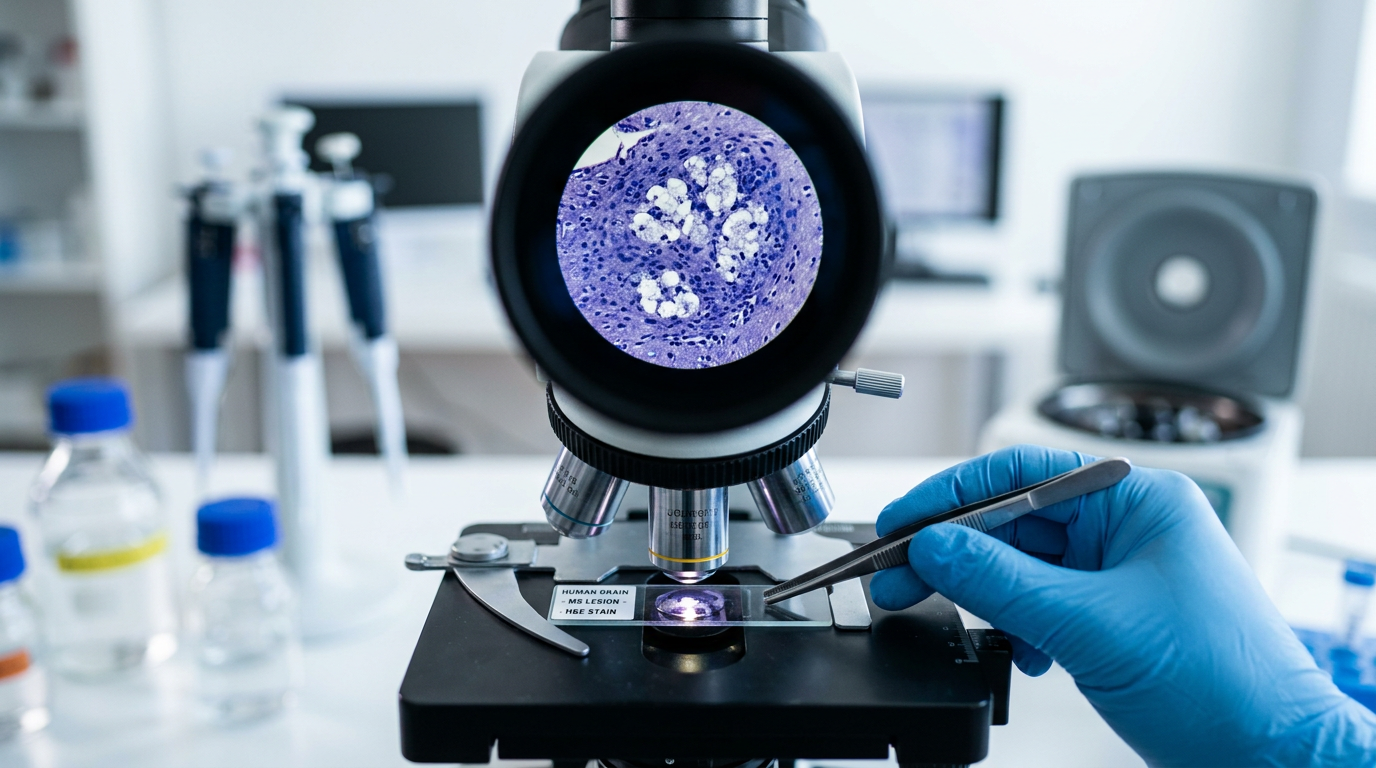
- The study investigated fundamental regulators of central nervous system myelination and repair, particularly in the context of white matter diseases.
- Researchers used a Retsat variant (Q247R) found in high-altitude species to study its effects in mice.
- Mice with the Q247R variant showed reduced neonatal hypoxia-induced hypomyelination and enhanced remyelination in adulthood.
- The authors concluded that Retsat and dihydroretinoids are pivotal regulators of white matter integrity.
- Administration of all-trans-13,14-dihydroretinol (ATDR) potently promotes remyelination, suggesting a potential therapeutic avenue for white matter diseases.
The Persistent Challenge of Myelin Repair in Neurological Disease
Myelin, the insulating sheath around central nervous system axons, is critical for neuronal function and survival [1]. Its loss in diseases like multiple sclerosis (MS) or after spinal cord injury leads to impaired nerve conduction and progressive axonal degeneration, resulting in cumulative disability [2, 3, 4]. While the central nervous system has an innate capacity for myelin repair, this process is frequently inefficient or fails entirely in chronic conditions, leaving patients with irreversible deficits [3, 5]. Consequently, developing therapies that directly promote remyelination, rather than only modulating the immune system, remains a major unmet need in clinical neurology [6, 7]. A deeper understanding of the fundamental molecular regulators of myelination is essential to creating such restorative treatments [8, 9].
High-Altitude Adaptation Points to a Myelination Regulator
To identify fundamental regulators of myelination, researchers turned to evolutionary genetics, examining a specific variant of the enzyme Retinol Saturase (Retsat). This variant, Q247R, is found in species adapted to high-altitude, low-oxygen environments. The investigators hypothesized that this adaptation might confer resistance to hypoxia-induced white matter injury. Their work in mouse models confirmed this, revealing that animals harboring the Retsat Q247R variant were protected from myelin loss. Specifically, the mice showed reduced neonatal hypoxia-induced hypomyelination and, as adults, exhibited enhanced remyelination following injury. These initial findings suggested that the Retsat enzyme plays a central role not only in protecting myelin but also in actively promoting its repair, providing a clear target for mechanistic investigation.
Unpacking the Neuron-to-Glia Signaling Cascade
The study then delineated the molecular pathway responsible for these protective and reparative effects. The Retsat Q247R variant was found to have heightened enzymatic activity, leading to increased neuronal production of a specific molecule, all-trans-13,14-dihydroretinol (ATDR). The researchers determined this process to be non-cell autonomous; the effect on myelination does not arise from within the myelin-producing oligodendrocytes themselves but is driven by a signal originating from neurons. This finding established a clear neuron-to-glia communication axis. Inside the neuron, ATDR is converted into all-trans-dihydroretinoic acid, which then functions as a neuron-to-glia paracrine signal, a short-range chemical messenger that travels from the neuron to adjacent glial cells. This signal specifically targets oligodendrocyte progenitor cells, the precursors to mature oligodendrocytes. By activating the Retinoid X Receptor gamma (RXR-γ) pathway, a key molecular switch involved in cellular maturation, the signal stimulates the differentiation of these progenitor cells and drives the formation of new myelin.
Therapeutic Potential of Dihydroretinoids
The elucidation of this pathway carries direct therapeutic implications for demyelinating diseases. Building on their mechanistic findings, the researchers demonstrated that systemic administration of all-trans-13,14-dihydroretinol (ATDR), which functions as a prodrug, potently promotes remyelination across multiple preclinical models of myelin injury. This suggests that pharmacologically supplying this key signaling molecule can effectively stimulate the body's own repair machinery. By tracing a genetic adaptation from high-altitude species down to a specific molecular cascade, the study identifies both the Retsat enzyme and its downstream products, the dihydroretinoids, as pivotal regulators of white matter integrity. This work provides a strong rationale for developing dihydroretinoid-based therapies to promote myelin repair in conditions like multiple sclerosis and other disorders of white matter.
References
1. Stadelmann C, Timmler S, Barrantes‐Freer A, Simons M. Myelin in the Central Nervous System: Structure, Function, and Pathology. Physiological Reviews. 2019. doi:10.1152/physrev.00031.2018
2. Trapp BD, Peterson JW, Ransohoff RM, Rudick RA, Mørk S, Bø L. Axonal Transection in the Lesions of Multiple Sclerosis. New England Journal of Medicine. 1998. doi:10.1056/nejm199801293380502
3. Niu J, Verkhratsky A, Butt A, Yi C. Demyelination and Remyelination: General Principles.. Advances in neurobiology. 2025. doi:10.1007/978-3-031-87919-7_9
4. Absinta M, Sati P, Masuzzo F, et al. Association of Chronic Active Multiple Sclerosis Lesions With Disability In Vivo. JAMA Neurology. 2019. doi:10.1001/jamaneurol.2019.2399
5. Dombrowski Y, O’Hagan T, Dittmer M, et al. Regulatory T cells promote myelin regeneration in the central nervous system. Nature Neuroscience. 2017. doi:10.1038/nn.4528
6. Dobson R, Giovannoni G. Multiple sclerosis – a review. European Journal of Neurology. 2018. doi:10.1111/ene.13819
7. Sarrazin N, Arab R, Cordano C, et al. Clemastine fumarate promotes myelin repair in a nonhuman primate model of demyelination characterized by absent spontaneous remyelination.. Proceedings of the National Academy of Sciences of the United States of America. 2026. doi:10.1073/pnas.2520161123
8. Hu X, Xu W, Ren Y, et al. Spinal cord injury: molecular mechanisms and therapeutic interventions. Signal Transduction and Targeted Therapy. 2023. doi:10.1038/s41392-023-01477-6
9. Alizadeh A, Dyck SM, Karimi‐Abdolrezaee S. Traumatic Spinal Cord Injury: An Overview of Pathophysiology, Models and Acute Injury Mechanisms. Frontiers in Neurology. 2019. doi:10.3389/fneur.2019.00282