
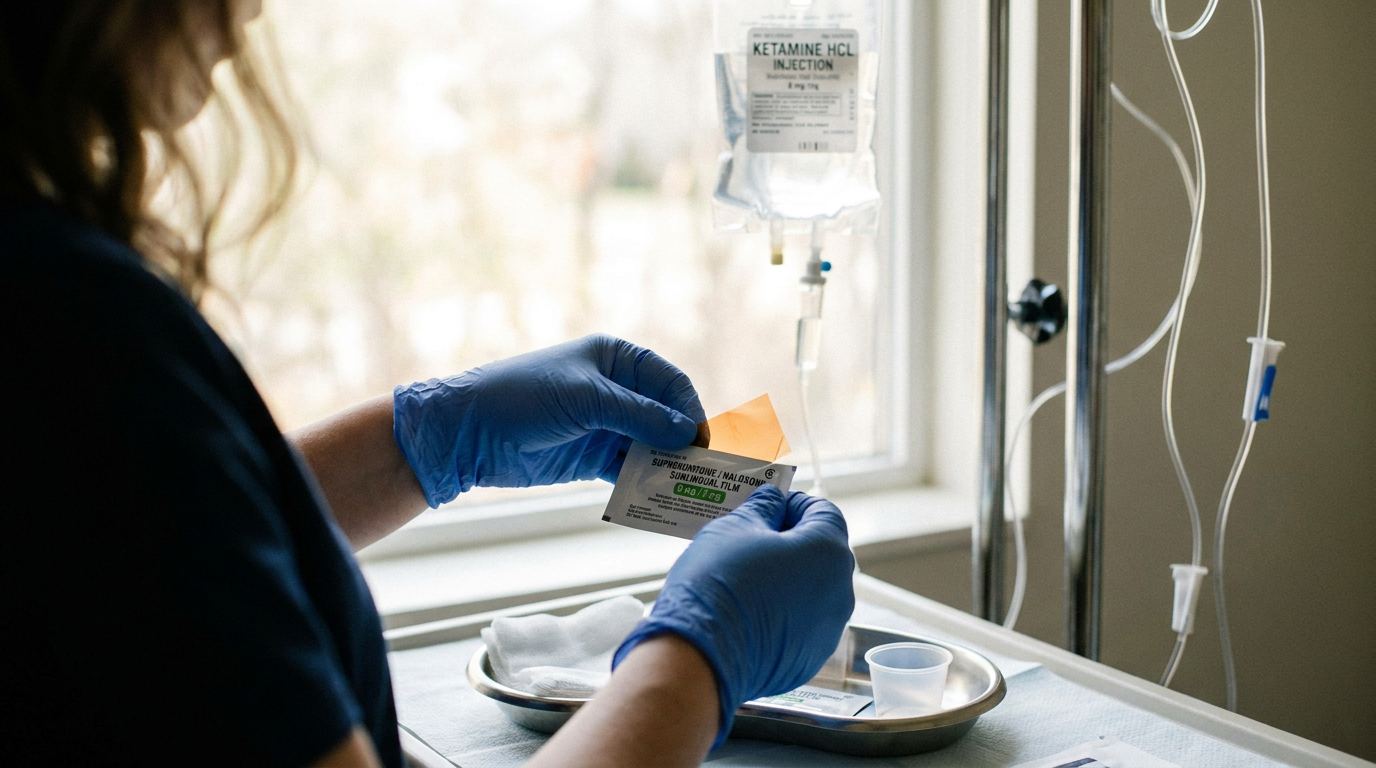
- Ketamine rapidly reduces suicidal ideation in major depressive disorder, but its effects are transient.
- This randomized, double-blind, placebo-controlled trial included 50 participants with MDD, 45 of whom completed follow-on treatment.
- Buprenorphine significantly reduced suicidal ideation (mean change -11.6) compared to placebo (mean change -6.3), with a Glass delta of 0.76 (95% CI 0.11, 1.39).
- The authors concluded that buprenorphine significantly sustains and enhances ketamine's antisuicidal effects in MDD.
- This offers a potentially scalable and safe therapeutic option for patients at risk of suicide.
Extending Ketamine's Antisuicidal Impact
For patients with major depressive disorder (MDD), particularly the many who experience suicidal ideation, the need for effective and sustained interventions is urgent [1, 2, 3]. Intravenous ketamine offers a rapid reduction in these thoughts, but its benefits are often transient, creating a critical window of vulnerability after the initial improvement fades [4]. This has spurred a search for strategies to prolong ketamine's effects. One area of investigation involves the brain's endogenous opioid system, as evidence suggests ketamine's actions may be partly mediated through mu-opioid receptor modulation [5, 6]. This hypothesis provides a clear rationale for exploring buprenorphine, a partial mu-opioid receptor agonist, as a potential maintenance therapy [7]. A recent randomized, double-blind, placebo-controlled trial directly tested this strategy, examining if low-dose sublingual buprenorphine could safely extend the antisuicidal benefits of a single ketamine infusion [8].
Addressing Transient Ketamine Effects
The central clinical challenge with ketamine is not its initial efficacy but its durability. While a single infusion can rapidly reduce suicidal ideation in major depressive disorder (MDD), these effects often wane within days, leaving clinicians and patients searching for a way to maintain the gains. The study's hypothesis was built on evidence that ketamine's therapeutic action may involve the brain's mu-opioid receptor (MOR) system. This led researchers to investigate whether a follow-on treatment with low-dose sublingual buprenorphine, a partial MOR agonist, could serve as a pharmacological bridge. The specific objective was to determine if this sequential treatment could sustain and enhance the initial antisuicidal effects of ketamine, providing a more durable therapeutic response for a high-risk population.
Trial Design and Participant Characteristics
To test their hypothesis, the investigators employed a robust randomized, double-blind, placebo-controlled trial at a single outpatient center in the United States. The study enrolled adults with MDD who presented with significant suicidal ideation, defined by a score of 6 or higher on the Scale for Suicide Ideation (SSI). The trial followed a two-phase protocol. First, all participants received a single open-label intravenous ketamine infusion at a dose of 0.5 mg/kg over 40 minutes. Forty-eight hours later, they were randomly assigned in a 1:1 ratio to a 4-week follow-on treatment of either sublingual buprenorphine (0.2 to 0.8 mg/day) or a matched placebo. The primary outcome was the change in the SSI total score, assessed weekly from day 1 through day 31. Between November 2020 and March 2025, 50 participants (68% female) received the initial ketamine infusion, and 45 of them completed at least one week of the follow-on treatment.
Buprenorphine's Impact on Suicidal Ideation
The study's primary analysis revealed a clear benefit for the buprenorphine follow-on strategy. While both groups experienced a reduction in suicidal ideation after the initial ketamine infusion, the improvement was substantially greater and more sustained in the active treatment arm. The buprenorphine group (N=23) had a mean reduction of -11.6 points on the Scale for Suicide Ideation (SSI), compared to a mean reduction of -6.3 points in the placebo group (N=22). This difference yielded a Glass delta effect size of 0.76 (95% CI=0.11, 1.39), indicating a moderate to large treatment effect. Furthermore, a statistical analysis using mixed-effects modeling, a method that evaluates change over multiple time points, showed a significant time-by-treatment interaction (p<0.001). This result confirms that the trajectories of improvement for the two groups diverged significantly over the 4-week study period, with the buprenorphine group maintaining a superior response.
Safety Profile and Broader Implications
The therapeutic benefit of buprenorphine appeared to be specific to suicidal ideation, as the study found that overall depression scores did not differ significantly between the treatment and placebo groups. From a clinical safety standpoint, the intervention was well tolerated; no serious treatment-related adverse events occurred during the 4-week follow-on period. This is a critical finding for a medication being considered for outpatient use in a vulnerable population. The authors conclude that this trial provides the first randomized controlled evidence that a pharmacological intervention can successfully sustain and enhance the antisuicidal effects of ketamine in MDD. For practicing physicians, these findings suggest a potential, readily scalable, and safe therapeutic sequence for managing patients at high risk of suicide, offering a way to extend the therapeutic window opened by an initial ketamine treatment.
References
1. Namiot ED, Smirnovová D, Sokolov AV, Chubarev VN, Tarasov VV, Schiöth HB. Depression clinical trials worldwide: a systematic analysis of the ICTRP and comparison with ClinicalTrials.gov. Translational Psychiatry. 2024. doi:10.1038/s41398-024-03031-6
2. Sakurai H, Yonezawa K, Tani H, Mimura M, Bauer M, Uchida H. Novel Antidepressants in the Pipeline (Phase II and III): A Systematic Review of the US Clinical Trials Registry. Pharmacopsychiatry. 2022. doi:10.1055/a-1714-9097
3. Scott F, Hampsey E, Gnanapragasam S, et al. Systematic review and meta-analysis of augmentation and combination treatments for early-stage treatment-resistant depression. Journal of Psychopharmacology. 2022. doi:10.1177/02698811221104058
4. Abbar M, Dematteï C, El‐Hage W, et al. Ketamine for the acute treatment of severe suicidal ideation: double blind, randomised placebo controlled trial. BMJ. 2022. doi:10.1136/bmj-2021-067194
5. Serafini G, Adavastro G, Canepa G, et al. The Efficacy of Buprenorphine in Major Depression, Treatment-Resistant Depression and Suicidal Behavior: A Systematic Review. International Journal of Molecular Sciences. 2018. doi:10.3390/ijms19082410
6. Fava M, Memişoğlu A, Thase ME, et al. Opioid Modulation With Buprenorphine/Samidorphan as Adjunctive Treatment for Inadequate Response to Antidepressants: A Randomized Double-Blind Placebo-Controlled Trial. American Journal of Psychiatry. 2016. doi:10.1176/appi.ajp.2015.15070921
7. Riblet N, Young-Xu Y, Shiner B, Schnurr P, Watts B. The efficacy and safety of buprenorphine for the treatment of depression: A systematic review and meta-analysis. Journal of Psychiatric Research. 2023. doi:10.1016/j.jpsychires.2023.03.037
8. Tucciarone JM, Bandeira ID, Blasey C, et al. Low-Dose Buprenorphine Following Ketamine Treatment for Suicidal Ideation in Major Depressive Disorder: A Randomized, Double-Blind, Placebo-Controlled Trial.. The American journal of psychiatry. 2026. doi:10.1176/appi.ajp.20250840